
Preparation and Training
The Via Francigena is a long and diverse route, alternating between dirt tracks, paved roads and mountain paths. It does not present any particular technical challenges but demands stamina and consistency.
However, there are completely isolated mountainous sections, with frequent ups and downs and significant elevation changes. This is especially true on the final stretch in France, such as on the stage towards Pontarlier up to the source of the River Loue, or in Switzerland. In Italy, too, the route is demanding, particularly in the Alps in the Aosta Valley and the Apennines after Fornovo di Taro, where caution is important. For example, on the stage towards Pontremoli, after the Cisa Pass, the descent towards Groppoli over rocky terrain puts a heavy strain on knees and ligaments.
More than technical difficulty, the real challenge is the duration.
Should I train?
Walking is a natural activity, so no special preparation is needed. However, it's crucial to condition your body for consistent, repeated exertion.
I recommend these simple tips:
- Walk at least 1 hour daily in the 1–2 months before starting (including varied terrain)
- Go on longer walks during the weekends
- Try walking with a rucksack to get your back and joints accustomed to it
The goal is to start with a good level of fitness so you can enjoy the walk and scenery without pain or fatigue.
While walking
Remember, it’s not a race. Your body needs time to adapt.
In the beginning, feeling tired or experiencing minor aches is normal, but the walk itself becomes training: week by week, your stamina improves, your stride smooths, and discomfort decreases.
Keep in mind, too, that the English and French sections are mostly flat; allowing your body to gradually adapt before tackling the more challenging climbs in the final parts of France and in Switzerland and Italy.
The real challenge
The Via Francigena is accessible for an average walker, but requires:
- Good overall fitness
- Ability to walk for many hours
- Ability to carry a rucksack for several consecutive days
The mental aspect
More than physical readiness, it’s all in the mind. It’s a journey lasting about three and a half months, walking nearly every day, taking it one step at a time.
You’ll face tough moments, tiredness, bad weather, minor aches, or just a lack of motivation. During these times, perseverance and determination are key. Maintaining a positive mental attitude and not giving up despite difficulties matters.
A positive attitude helps your body overcome obstacles: it's no accident that my motto is Where the body cannot go, the mind can, and the mind drives the body.
Solitude and rhythm
In some parts, especially in France and Switzerland, you may walk alone for entire days, on remote trails. For some, this is positive; for others, it can be challenging. It's important to be aware of this before you start.
Establishing a daily routine helps greatly: consistent times, breaks, planning the next stage. This simple, steady rhythm allows you to go far without stress.
The secret
You don’t need to be an athlete: just persistence. This journey is for everyone, young and old.
One step at a time, facing daily challenges calmly – that’s how you go far… maybe as far as St. Peter’s Square in Rome.
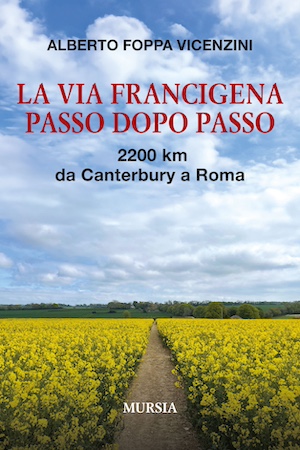
My book on the Via Francigena from Canterbury to Rome
In my book, I explain how my body and mind adapted to the journey, transforming the initial fatigue into strength and awareness over a distance of more than 2,200 km.
Written in Italian, based on my personal journey.
Read the book